
FACULTY PROFILE
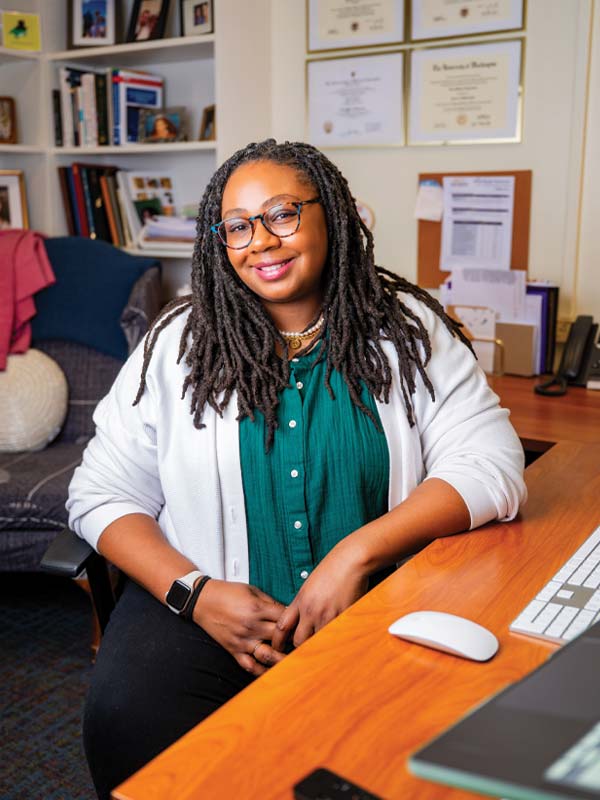
Dr. Reva Zimmerman
DR. REVA ZIMMERMAN:
A VOICE FOR THE VULNERABLE
For Dr. Reva Zimmerman, graduate education is not only a bridge between theory and real-life crises. It’s how she equips herself and students to advocate for the vulnerable.
Dr. Zimmerman earned bachelor’s degrees in linguistics and communication sciences and disorders. Before entering higher education, she began her career working directly with adults in post-acute and skilled nursing settings.
“I love language,” she reflects. “To me, it’s the most powerful tool we possess as a species, whether we’re thinking to ourselves or having conversations with people. Considering people who lose their ability to use their language effectively was what led me toward the study of aphasia.”
Aphasia is an acquired language disorder commonly caused by stroke. Dr. Zimmerman’s research is especially focused on factors that predict treatment outcomes and why some individuals benefit more from treatment than others. Secondary research interests in social determinants of health and diversity, equity, and inclusion (DEI) further inform her work, particularly given persistent racial disparities in stroke outcomes and access to care.
All of us have a shared vision of cultivating strong patient-centered clinicians for the future.
It was her master’s in speech-language pathology and her Ph.D. in communication sciences and disorders, however, that taught her the skills she needed to work with stroke survivors. Theories taught at the undergraduate level did not make the connection between language and other thinking skills, like attention or memory. “I’d find myself working with patients who seemed to have more than just language issues. Sometimes those additional issues would get in the way of treatment.” She was driven to higher education by her desire for models that integrated language and cognition to help clinicians understand how to work out each piece.
Now graduate coordinator of the University’s speech-language pathology program, Dr. Zimmerman oversees recruitment, advisement, admissions, and student support. The position is administrative by necessity, but for her, it is deeply human. “Graduate students are under immense pressure academically, financially, emotionally,” she notes. “My role is to help them navigate those demands while keeping sight of why they came into this field in the first place.”
These priorities converge in the Stroke, Inclusion, Diversity, and Equity (StrIDE) Communication Lab, which Dr. Zimmerman founded to help stroke survivors do more than simply survive. Through interviews and community-based research, StrIDE centers the experiences of people who have lost their ability to communicate — and, often, their ability to advocate for themselves. “My hope is to create a community of stroke survivors who feel empowered to engage in advocacy,” she says, “or if nothing else, just engage in their own lives more fully.”
Graduate students play a critical role in this work. They learn that they are not just trainees, but contributors: to research, to clinical practice, and to their communities. Many present at regional and national conferences, while others gain hands-on experience in the program’s on-site clinic and community placements.
“What I hope students in clinical graduate programs learn is how to be caring, responsive, and person-centered practitioners,” Dr. Zimmerman reflects. “And I am proud to work alongside my colleagues in the College of Health Sciences. All of us have a shared vision of cultivating strong patient-centered clinicians for the future.”
In giving a voice to those who have lost theirs — and in preparing students to do the same — Dr. Zimmerman exemplifies how graduate education can bridge gaps, foster advocacy, and create meaningful change.
More from the Spring 2026 Issue

News
School of Nursing
announced at 50+ year celebration
STEM Inclusion
Secures Largest Grant in WCU’s History
Dr. Martin Luther King, Jr.
Celebrating His Legacy
Profiles
Donor:
Paul Christ
Alumni:
Patrick O'Connor M’93
Faculty:
Dr. Reva Zimmerman
Student:
John Crouser M’24