

UNIVERSITY NEWS
WCU Announces School of Nursing
at Anniversary Celebration for its Nursing Programs’ 50+ Years
WCU nursing alumni, students, faculty, staff, and partners were thrilled with the surprise announcement that a School of Nursing within the College of Health Sciences has become a reality.
More than 100 gathered in the ballroom of the Sciences and Engineering Center & The Commons (SECC) in the fall to celebrate the 50+ anniversary of the University’s nursing programs. Students in the Department of Nursing led tours of an impressive, technologically advanced Duey Immersive Learning Center, demonstrating how high-fidelity patient mannequins simulate real-life scenarios found in today’s emergency rooms. Guests also viewed a retrospective display of historical nursing photos and artifacts from across the years. Among the artifacts featured were a 1970’s nursing cap, as well as one of the first official nursing pins distributed in 1976. Nursing’s dramatic transformation was also shared through the personal stories of alumni and faculty panelists who spoke about evolving healthcare challenges and the profession’s sweeping changes.
In a video tribute to the development of WCU’s many nursing programs, the narrator’s concluding words were unexpected: “From school nursing courses in the 1950s to doctoral education today, the journey of West Chester Nursing reflects tradition, transformation, and excellence. … Congratulations to West Chester University Nursing on more than 50 years of shaping the future of healthcare. As we look ahead, we celebrate not only our past, but our future — because in January 2026, the Department of Nursing will officially become the School of Nursing within the College of Health Sciences.”
Thunderous applause erupted as University President Dr. Laurie Bernotsky stepped to the podium. “Congratulations!” she said. “All of you — alumni, students, faculty, and staff — have made this come true and you have so much to be proud of today. I’d like you to know how hard your dean, Dr. Scott Heinerichs, has been advocating for this moment for all of you and for future generations of nurses; he understands how to chart a vision and get something done.
“At their last meeting, members of our Council of Trustees were delighted to unanimously pass the official resolution for the School of Nursing. There were no questions asked, because of all the hard, successful work that has been done over the years to get to this moment. This is a day to remember.”
Dr. Heinerichs expressed his congratulations to the audience members, some of whom had tears. “All of you make this easy,” he said. “Our students maintain a 95% pass rate on the national licensing exam for registered nurses and this success rate continues to exceed state and national averages. We have numerous nursing students who enroll to study with our extraordinary faculty. We have outstanding clinical partners, many of whom are with us today. We have this beautiful facility, and our Immersive Learning Center.
“Everything in life is about the journey and not the destination. All of you are why we are here, and we are happy that you are with us today to share in this absolute joy. You deserve this.”
Chair of the Nursing Department Dr. Nancy Barker was emotional as she addressed the audience. “We are celebrating our story, our history, our moment. The vision that took root here has blossomed. Here’s to more than 50 years of excellence and to the countless lives yet to be touched by WCU nurses. Congratulations to all of you!”
Following the celebration, excited nursing alumni formed a line outside of the ballroom to secure one of the first School of Nursing legacy T-shirts.
The University’s announcement of a School of Nursing comes at a critical time. America’s aging population has created a surge in demand for intensive medical services. This challenge is compounded by widespread retirements throughout the healthcare sector that make the stakes high for overstretched teams struggling to deliver quality care for patients.
WCU nursing graduates continue to be in great demand and can be found working in hospitals (medical-surgical units, telemetry, step-down, etc.), rehabilitation centers or long-term care facilities, community health agencies or public health settings, as well as physicians’ offices or outpatient care clinics. After gaining some clinical experience, many bachelor of science in nursing (BSN) graduates also go on to graduate study (i.e., master of science in nursing (MSN), doctor of nursing practice (DNP), or other advanced studies). Clinical nurse specialist (CNS) graduates work in advanced practice roles focusing on a specialty (i.e., adult-gerontology) with emphasis on evidence-based practice, patient populations, or care systems. WCU’s nurse educator graduates work in various teaching roles — either in academic settings preparing future nurses, or within hospitals offering education/ continuing education programs to clinical staff. In addition, many of the University’s DNP graduates go into high-level advanced practice or leadership roles.
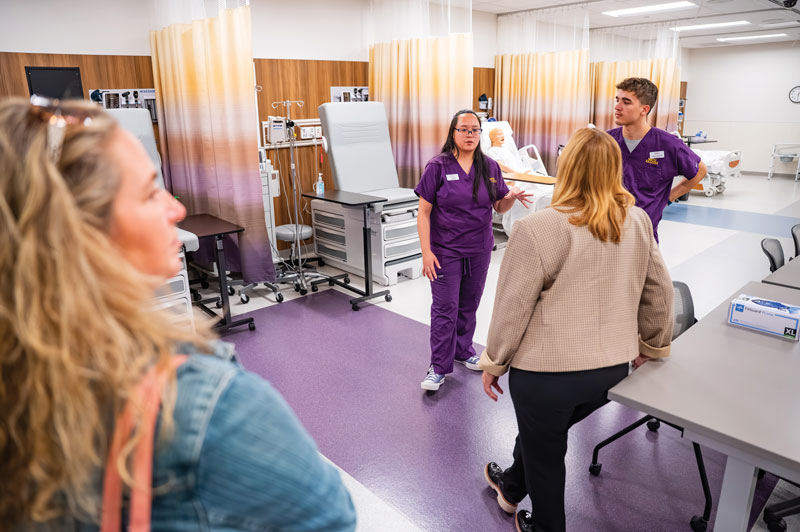
During the anniversary celebration of the nursing programs’ 50+ years, WCU nursing students (L-R) Christina Ngo and Adam Hudson shared details about the state-of-the-art Immersive Learning Center’s advanced capabilities with WCU alumni.
More from the Spring 2026 Issue




News
School of Nursing
announced at 50+ year celebration
STEM Inclusion
Secures Largest Grant in WCU’s History
Dr. Martin Luther King, Jr.
Celebrating His Legacy
Profiles
Donor:
Paul Christ
Alumni:
Patrick O'Connor M’93
Faculty:
Dr. Reva Zimmerman
Student:
John Crouser M’24